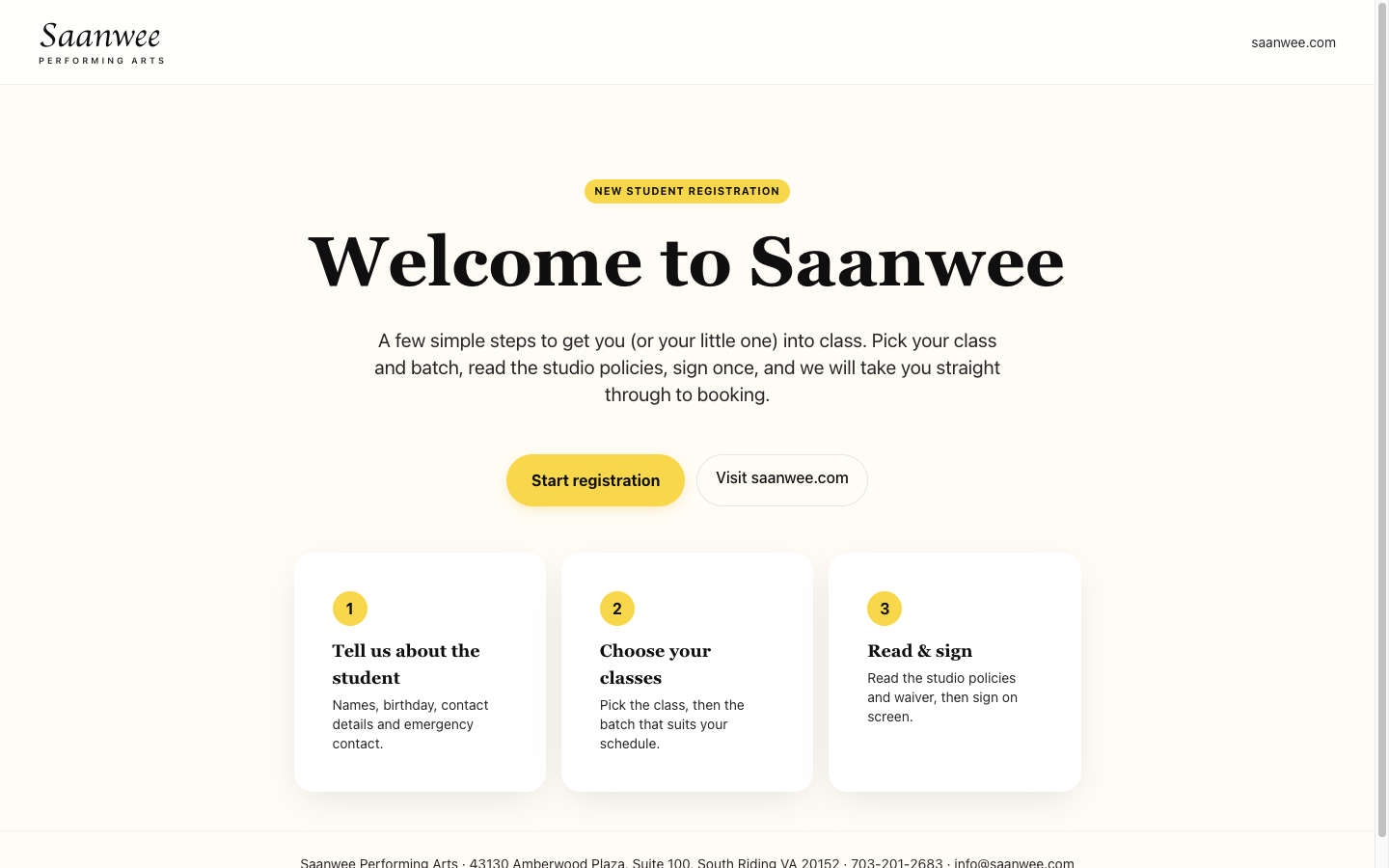
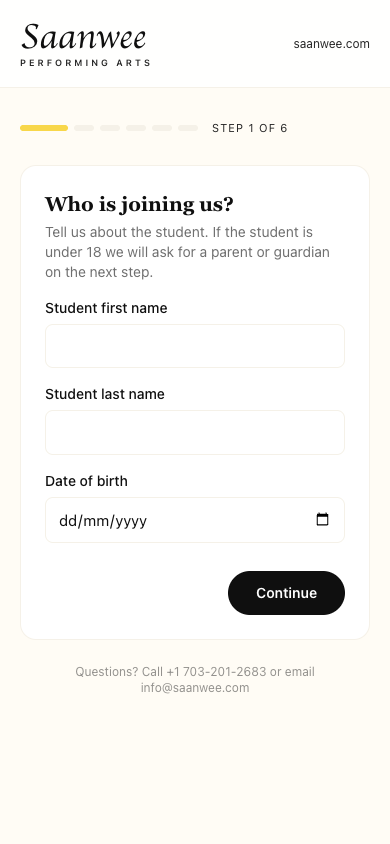
Saanwee run music and dance classes for students of every age. Enrolling meant a printed form, a policy sheet nobody read, and a signature chased on the day. We built a six-step registration that knows when the student is a minor, shows the actual policies, and captures a real signature before anyone walks in.

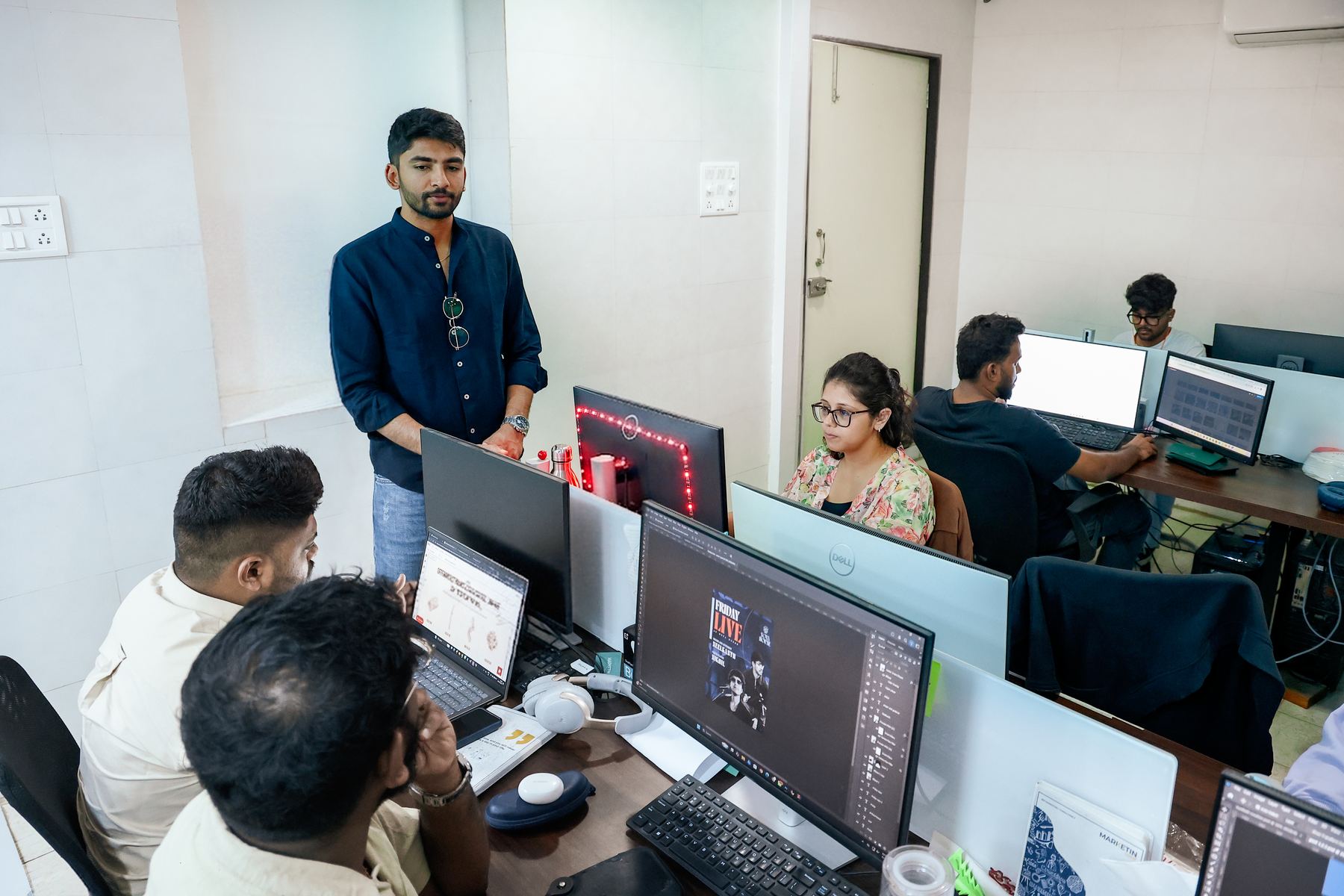
Founders and professionals talk to Manan. The building, testing and support happens here, in the room.
A performing arts studio has the same three problems every term. Details arrive on paper and get typed in twice. The policy sheet is handed over without being opened. And the signature that actually matters legally is the one collected in a rush at the door on day one.
Paper form to spreadsheet, by hand, with a transcription error every few students.
Which changes who has to consent, and nobody wants to work that out at the door.
A name on a line proves very little about what the person was shown.

The parent gets one screen at a time, in plain language, and never sees a question that does not apply to them.

Name, birthday, contact. The date of birth is what drives everything that follows.
Under eighteen and the form asks for a parent or guardian. Over eighteen and that step never appears.
Pick the class, then the batch that suits the schedule, instead of a free-text box the office decodes later.
The studio's real policy documents, on screen, before the signature rather than in a folder afterwards.
A drawn signature with a timestamp, captured with a finger, which is how a phone signature should work.
Logged where the office already works, so nobody retypes anything and the signed copy is kept.
One screen at a time, in plain language, and never a question that does not apply.
The form does the thinking.
Name, birthday, contact. The date of birth drives the rest.
Under eighteen, it asks for a parent. Over eighteen, the step never appears.
Pick the class, then the batch, instead of a free-text box.
The studio's own documents, on screen, before the signature.
A drawn signature with a timestamp.
Nobody retypes anything, and the signed copy is kept.
Anyone can collect a signature. The part that matters, if it ever matters, is proving which version of the terms that person actually saw, on what date, and who was legally able to agree to them.
The policies are presented from the studio's own documents, not paraphrased into friendlier wording that would not hold up.
Minor detection is not a checkbox the parent ticks. It follows from the date of birth, so it cannot be skipped by accident.
Timestamped, with the signature attached, in the place the studio already keeps its student records.